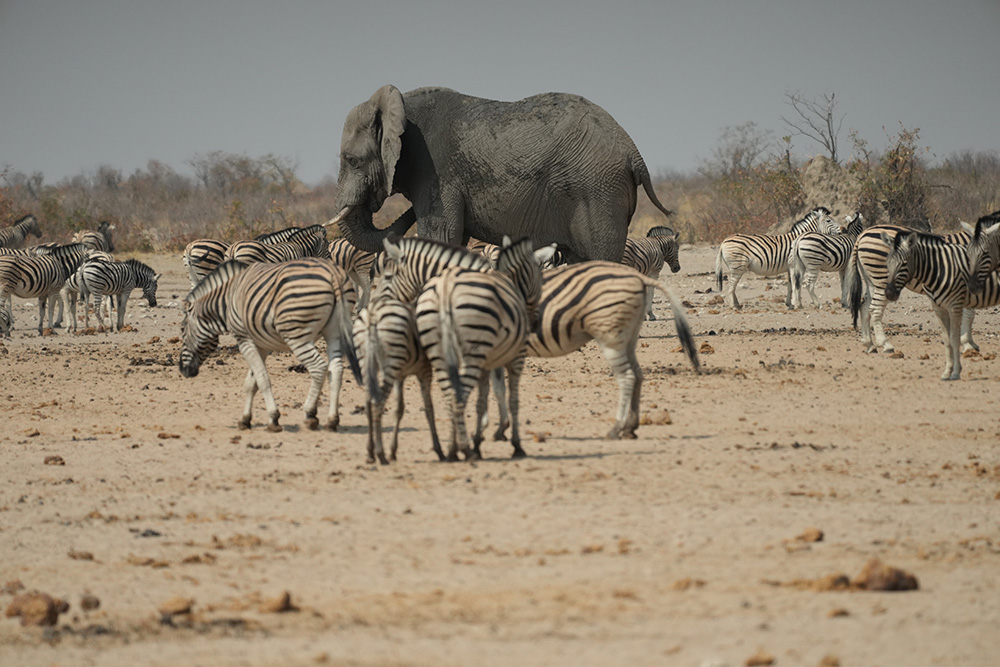
Etosha National Park is one of Africa's great wildlife destinations — a vast, white salt pan ringed by thornbush and ancient waterholes where elephant, lion, rhino, cheetah and hundreds of bird species converge in extraordinary numbers. This guide covers everything you need to plan a self-drive visit, from gate times and entry fees to the best waterholes and where to stay.
Where is Etosha National Park?
Etosha National Park is in northern Namibia, approximately 450 km north of Windhoek. The nearest towns are Outjo (south), Tsumeb (east) and Ondangwa (north).
The park sits above the Tropic of Capricorn in the heart of northern Namibia. It covers 22,270 km² — about the size of Wales — with the Etosha Pan occupying around 4,800 km² of that area. There are four entrance gates:
| Gate | Best access from | Closest camp |
|---|---|---|
| Ombika Gate (formerly Anderson Gate) | Windhoek, Swakopmund, central Namibia | Okaukuejo, Halali |
| Namutoni Gate | Windhoek (via B1), Tsumeb | Namutoni, Halali, Onkoshi |
| Galton Gate | Swakopmund, Walvis Bay, Damaraland | Dolomite, Olifantsrus |
| King Nehale Gate | Northern Namibia (Ondangwa, Oshakati) | Onkoshi |
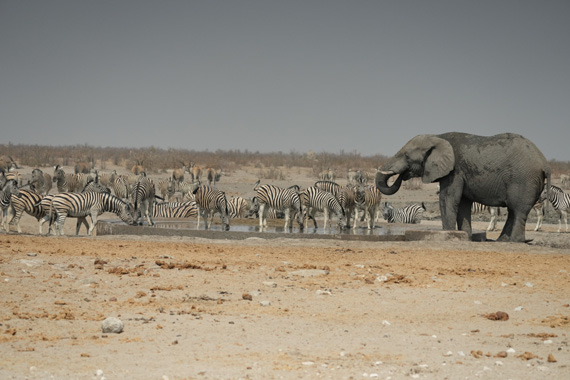
How to Get to Etosha National Park
Drive yourself or hire a car. Etosha is reached on good tar roads from all major Namibian towns. Self-driving gives you full flexibility to set your own pace inside the park.
All roads from Windhoek, Swakopmund, Walvis Bay and Tsumeb to the park gates are tarred. From Windhoek to Ombika/Anderson Gate is approximately 450 km — about 4.5 hours. The park is not accessible by public transport, and once inside, a vehicle is essential.
We work with reliable Namibian car hire companies — 2WD and 4WD available.
What If I Can't Drive or Rent a Car?
Three options: private transfer (expensive but efficient), the Go2 shuttle (affordable set routes), or a guided overnight safari tour. There is no Uber, Lyft or taxi service near Etosha.
Private Transfer
Transfer companies will pick you up and drop you at your accommodation. Efficient but expensive due to long distances. You will still need to pay for guided game drives from your lodge once inside.
Go2 Shuttle
A reliable and affordable shuttle service covering much of Namibia on set routes and times. Drop-off is at a designated lodge — if you are staying elsewhere, you will need to arrange a transfer. Note: no shuttle stops inside the park itself. Game drives must be booked separately through your accommodation.
Guided Overnight Safari
Several companies offer group or private overnight trips to Etosha. This is the most complete option for non-drivers — transport, accommodation, game drives and a guide are all included, though it is the most expensive route.
Etosha National Park Opening Hours
Etosha gates open at sunrise (approx. 06:30) and close at sunset (approx. 18:30 in summer, 18:00 in winter). Exact times are posted at each camp gate daily — always check before leaving camp.
Gate and camp closing times vary through the year and change with the seasons. The exact time for the following day is always posted at the exit gate of each camp. Do not rely on other visitors to tell you the closing time — always check the sign at the gate.
| Situation | Rule |
|---|---|
| Staying inside the park | Must be at your camp before gate closing time |
| Staying outside the park | Can enter at sunrise, must exit by sunset |
| Arriving a few minutes late | Likely a warning; possible fine |
| Arriving very late | Gate closed; manager call-out; fine issued |
| Repeated late arrival | Can result in ban from all Namibian national parks |
If you have a booking inside the park and arrive late at an entrance gate, rangers will calculate whether you can reach your camp before closing time. If you cannot, you will not be admitted — plan your drive times carefully.
Etosha Park Entry Fees
Foreign adults pay NAD 150 per person per day. Fees are charged per person AND per vehicle, payable for every 24 hours from time of entry. Minimum charge is one full day — no half-day rates.
| Category | Daily Fee (NAD) |
|---|---|
| Adult — Foreign visitor | NAD 150 |
| Child (9–16) — Foreign visitor | NAD 100 |
| Adult — SADC resident | NAD 100 |
| Child (9–16) — SADC resident | NAD 50 |
| Adult — Namibian | NAD 50 |
| Child (9–16) — Namibian | Free |
| Vehicle up to 10 seats | NAD 50 |
| Vehicle 11–25 seats | NAD 100 |
| Vehicle 26–50 seats | NAD 400 |
| Vehicle 51+ seats | NAD 700 |
Where to Pay
Park fees are collected by the Ministry of Environment, Forestry and Tourism (MEFT) — a separate desk to NWR check-in, but usually in the same reception building.
| Staying at | Pay park fees at |
|---|---|
| Okaukuejo Resort | MEFT desk at Okaukuejo reception |
| Halali Resort (via Ombika gate) | MEFT desk at Okaukuejo, then proceed to Halali |
| Namutoni Resort | MEFT desk at Namutoni reception |
| Onkoshi Resort | MEFT desk at Namutoni reception |
| Dolomite / Olifantsrus (from west) | Galton Gate |
| Dolomite / Olifantsrus (from east) | MEFT desk at Okaukuejo |
| Staying outside the park | At your entry gate (Okaukuejo or Namutoni) |
How Long Should I Stay in Etosha?
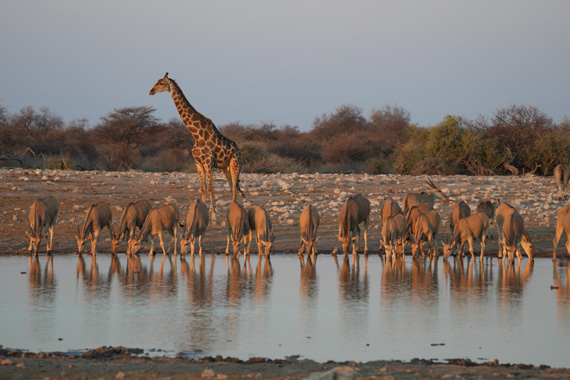
Minimum 2 nights for a general wildlife experience with 3–4 game drives. 3 nights gives a good chance of seeing most of the major species. 4–5+ nights for photographers, birders, or those seeking black rhino, leopard or cheetah.
| Your goal | Recommended stay |
|---|---|
| Part of a longer Namibia road trip | 2–3 nights |
| See the Big 5 (or most of them) | 3–4 nights |
| Dedicated bird watching | 2–3 nights (more in summer) |
| Photography / videography | 4+ nights minimum |
| Maximum wildlife experience | As long as possible |
Etosha is completely wild — longer stays in the same area compound your chances of seeing rarer animals. Lion, hyena and cheetah require patience. Black rhino and leopard require luck and time.
What Wildlife Can You See in Etosha?
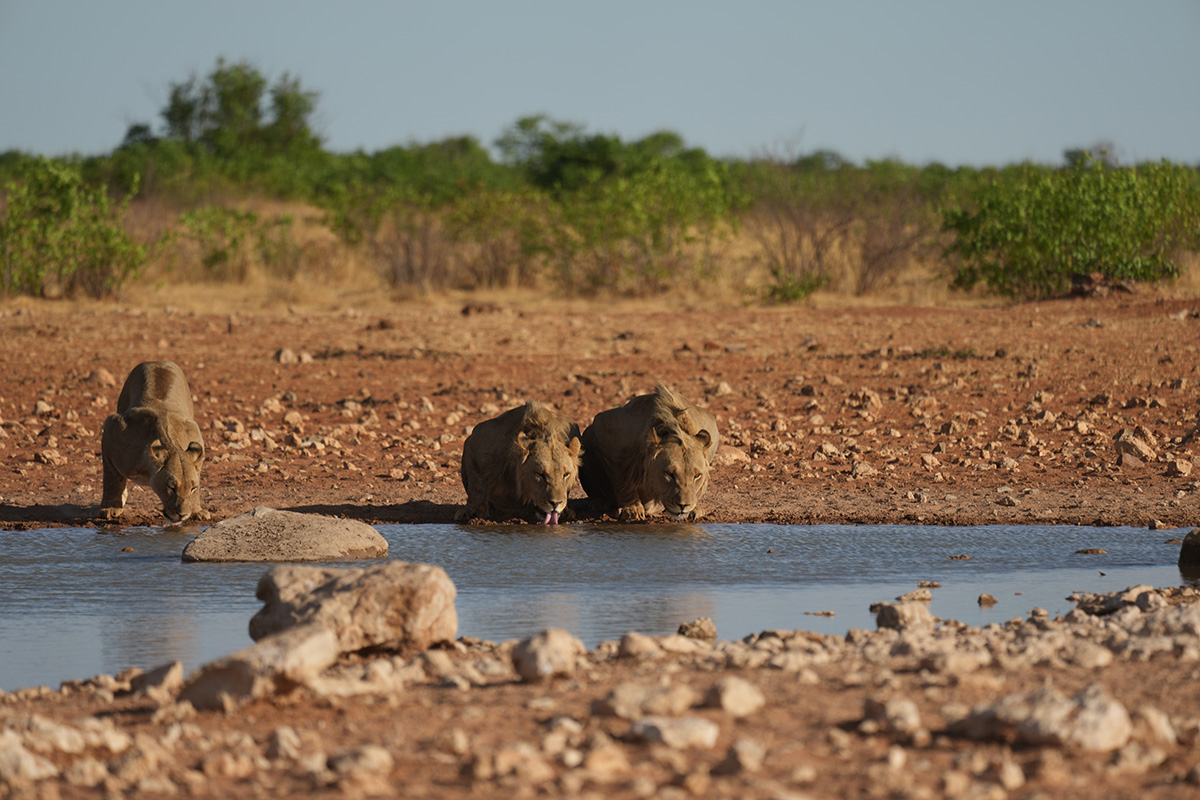
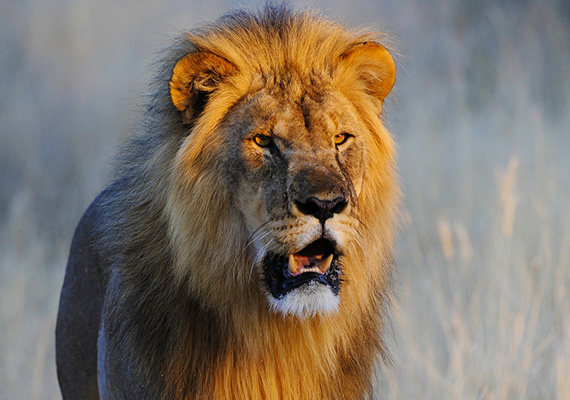
114 mammal species, 340+ bird species. Reliably: elephant, lion, both white and black rhino, giraffe, zebra, springbok, oryx, wildebeest, cheetah, spotted hyena. Rarer: leopard, pangolin, aardwolf, serval, brown hyena.
Best Time to Visit Etosha National Park
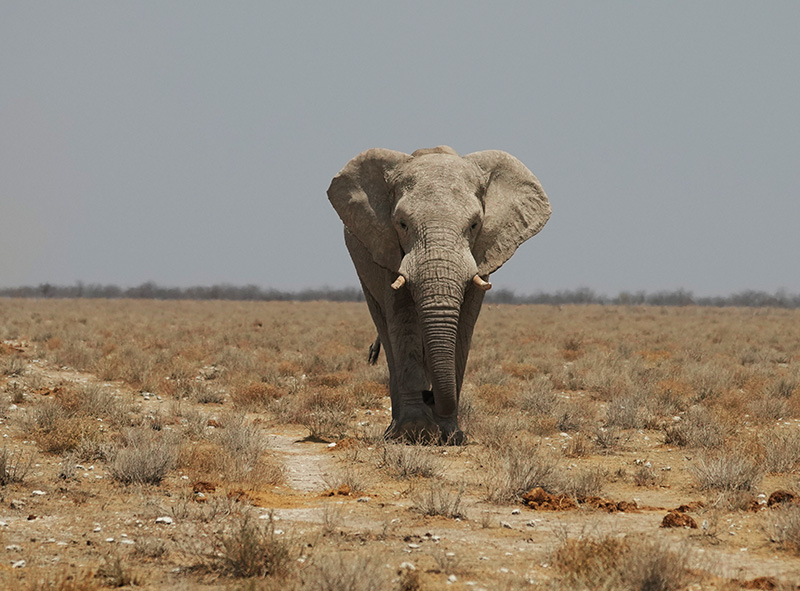
May to September is the peak season for game viewing — dry conditions push wildlife to waterholes and visibility is clear. April and November offer excellent value with fewer visitors. December to March is best for birding but hottest and wettest.
| Months | Conditions | Game Viewing | Crowds & Cost |
|---|---|---|---|
| May–September | Dry, cool to warm (20–30°C) | Excellent — large herds at waterholes | Peak season — book well in advance, highest prices |
| April & November | Transitional, some rain possible | Good — fewer visitors, lower vegetation | Shoulder — best value months |
| December–March | Hot (35–40°C), rainy season | Good — animals more active, green landscape, exceptional birding | Low season — fewest visitors, lowest prices |
Book accommodation with air conditioning if visiting December through March — temperatures regularly hit 38–40°C during the day.
All six camps — Okaukuejo, Halali, Namutoni, Onkoshi, Dolomite, Olifantsrus. No extra fees.
Can I Self-Drive Inside Etosha Park?
Yes. Etosha is one of Africa's best parks for self-driving. You can cover all the main roads and waterholes independently in your own or hired vehicle.
Rules for Self-Driving
- Stay in your vehicle at all times outside of camps and designated toilet/rest stops. This is both a safety rule and a legal requirement.
- Speed limit: 60 km/h on all gravel roads. For game viewing, drive at 20–40 km/h.
- No off-road driving. Stay on marked roads. Violations can result in vehicle impoundment.
- Observe gate times. You cannot drive after the gate closes — you must be inside your camp by sunset.
- Keep windows mostly closed when near lions, elephants or baboons.
What Vehicle Do You Need for Etosha?
A 4WD is not required. A standard 2WD car can drive all main Etosha roads. However, a high-clearance SUV or bakkie (pickup) is strongly recommended for comfort on corrugated gravel and better sightlines over the grass.
The roads inside Etosha are gravel but generally well-maintained. A low-ground-clearance sedan can manage in dry conditions but will be uncomfortable on corrugated sections and the lower seating position significantly reduces game-viewing visibility. A bakkie, SUV or camper gives a much better experience.
Guided Game Drives in Etosha
Guided drives are available at all six NWR camps inside the park. Book at reception as soon as you arrive — they fill up quickly. Night drives are only available through guided tours, not self-drive.
A guided game drive adds a knowledgeable ranger who knows the best routes and animal behaviour. Open vehicles give better sightlines than enclosed cars. Night drives — not available for self-drivers — are run by NWR from Okaukuejo, Halali, Namutoni and Olifantsrus and are a highlight of any Etosha visit.
Book guided drives at the reception desk where you check in. Demand is high during peak season, so book on arrival rather than waiting.
Where to Stay Inside Etosha Park
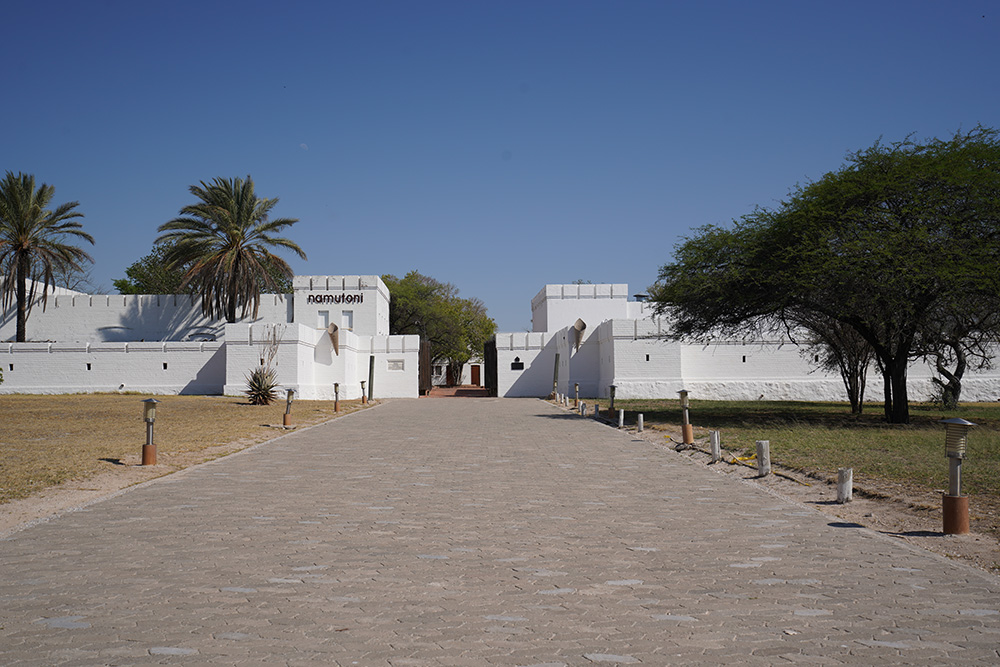
There are six NWR camps inside Etosha: Okaukuejo (west, famous waterhole), Halali (central, best rhino area), Namutoni (east, historic fort), Onkoshi (exclusive, pan views), Dolomite (western, unfenced), Olifantsrus (camping only, camp hide).
| Camp | Location | Best for | Accommodation |
|---|---|---|---|
| Okaukuejo Resort | West | Floodlit waterhole, all-round wildlife, easy access | Premier chalets, waterhole chalets, bush chalets, rooms, camping |
| Halali Resort | Central | Rhino, leopard at Moringa waterhole, most waterholes nearby | Bush chalets, rooms, camping, self-catering chalet |
| Namutoni Resort | East | Lions, cheetah, historic fort, greener vegetation | Bush chalets, rooms, camping |
| Onkoshi Eco Resort | East (pan edge) | Exclusive experience, pan views, unfenced | Private chalets on stilts (15 only) |
| Dolomite Eco Resort | Far west | Black rhino, remote, scenic ridge | Deluxe chalets, bush chalets (no camping, unfenced) |
| Olifantsrus Camping | Far west | Remote wilderness, unique camp hide | Camping only (with two-tier hide) |
Authorised agent — exact NWR prices, no booking fees.
Booking Etosha in Advance
Yes, you need to book in advance — especially for peak season (May–October). Popular accommodation types and specific camps book up more than a year ahead in peak months. Do not plan to turn up and find a room.
| Season | Months | Chance of walking in |
|---|---|---|
| Peak | May–October | Slim to none — book months or more in advance |
| Shoulder | April, November | 50/50 — limited choice, often only camping or premium rooms left |
| Low | December–March | Reasonable — but still book if you want a specific camp or room type |
Places to Stay Outside Etosha Park
Dozens of lodges, camps and guesthouses cluster near all four entry gates. Staying outside lets you enter at sunrise and exit by sunset — you miss the night waterholes but day game viewing is the same.
Near Namutoni Gate (east)
Onguma (The Fort, Bush Camp, Forest Camp, Tented Camp, Tamboti Campsite, Leadwood Campsite, Camp Kala, Trails Camp), Mushara Lodge, Mushara Bush Camp, Mushara Outpost, Villa Mushara, Mokuti Lodge, Emanya Lodge, Sachsenheim Guestfarm.
Near Ombika/Anderson Gate (south)
Etosha Village, Andersons at Ongava, Little Ongava, Ongava Tented Camp, Ongava Lodge, Etosha Trading Post, Eldorado Lodge, Etosha Safari Camp, Etosha Safari Campsite, Etosha Camping 2go, Etosha Lodge, The Ekipa, Toshari Lodge, Mondjila Tented Camp, Etosha Omusati Lodge.
Near Galton Gate (west)
Hobatere Lodge, Etosha Roadside Camping.
Near King Nehale Gate (north)
Etosha King Nehale Lodge.
We also book private lodges and camps near all four Etosha gates.
Is Etosha Safe to Visit?
Yes — Etosha is one of Africa's safest safari parks. Thousands of visitors travel independently every year without incident. Follow the rules: stay in your vehicle, observe gate times, and keep a safe distance from animals.
Wildlife safety
Stay in your vehicle outside camps and designated rest stops. Elephants, rhinos and big cats are unpredictable and dangerous on foot. Do not feed animals. Keep windows mostly closed near lions, elephants or baboons.
Camp safety
Okaukuejo, Halali, Namutoni and Olifantsrus are fully fenced — you can walk freely inside including to the waterholes. Onkoshi and Dolomite are unfenced — always ask a staff member to escort you after dark and take extra care at all times.
Driving safety
Gravel roads are well-maintained but animals cross without warning. Drive slowly, especially at dawn and dusk. The 60 km/h speed limit exists for a reason — zebra, springbok and elephant crossings are common.
Top 5 safety mistakes to avoid
- Getting out of your vehicle outside a designated stop — illegal and dangerous.
- Driving too fast — animals appear suddenly from the bush.
- Leaving camp late or arriving after gate closure — results in fines, potential ban.
- Approaching animals too closely — keep a respectful distance, especially from elephants and rhinos.
- Ignoring the rules at unfenced camps (Onkoshi, Dolomite) — animals genuinely walk through these camps.
Malaria in Etosha
Etosha is a low-to-moderate malaria risk area, not a high-risk zone. Risk is highest during the rainy season (November–April). Take precautions regardless of season. Consult your doctor before travel.
Precautions
- Sleep under a mosquito net (provided at most NWR camps).
- Use DEET or picaridin-based insect repellent.
- Wear long sleeves and trousers after dusk.
- Keep doors and windows closed in the evening.
- Consult your doctor about antimalarial prophylaxis before travel.
Most travel medicine doctors will recommend prophylaxis for Namibia regardless of season. The risk in the dry winter months (May–October) is substantially lower than in the wet season.
What Makes the Etosha Pan Special?
The Etosha Pan covers 4,800 km² — visible from space — and is the ecological engine of the park. In the dry season it is a blinding white salt flat with mirage effects. In good wet seasons it fills with shallow water and tens of thousands of flamingos.
The pan is a fossil lake formed millions of years ago when the Kunene River was diverted. Today it is a flat, white expanse of salt crust surrounded by natural springs and waterholes. In the dry season (May–October) these springs become the only water source for hundreds of kilometres, concentrating wildlife in extraordinary numbers around the pan edge. In exceptional wet years the pan floods briefly and becomes one of southern Africa's only flamingo breeding sites.
Best Waterholes in Etosha National Park
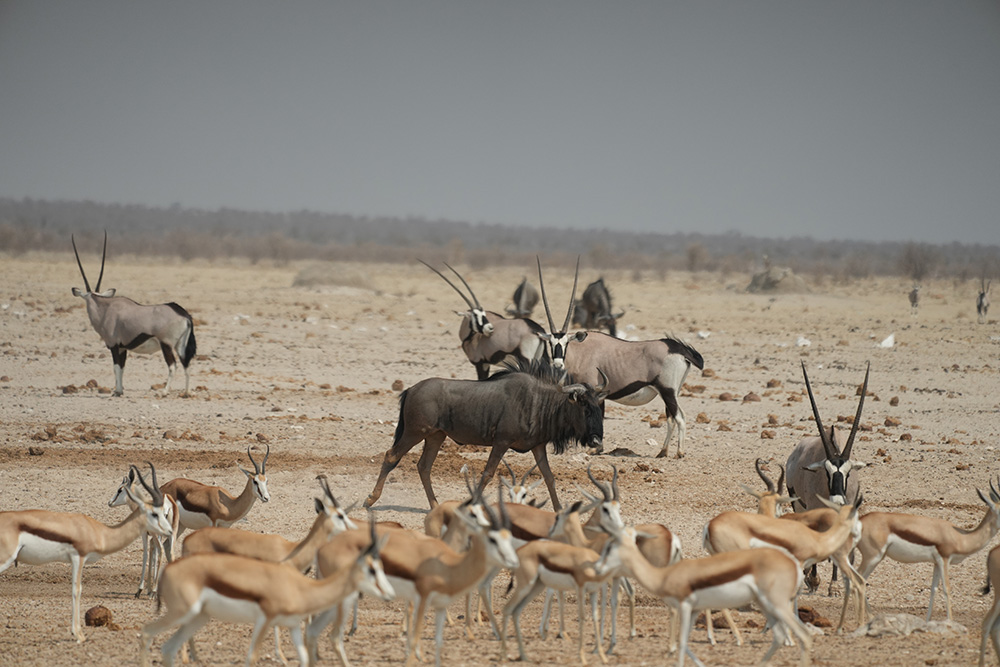
The best all-round waterhole is Okaukuejo (floodlit, day and night). Best for predators: Salvadora, Sueda, Chudop, Halali (Moringa). Best for elephants: Nebrowni, Gemsbokvlakte, Olifantsbad. Best for birds: Fisher's Pan in the wet season.
Okaukuejo Waterhole (inside Okaukuejo Camp)
The most famous waterhole in the park, floodlit at night. Regular sightings of black rhino, elephant herds, lions and giraffe. One of the best places in Africa to watch wildlife behaviour at night. Open 24/7 from inside the camp.
Moringa Waterhole, Halali (inside Halali Camp)
Natural rock amphitheatre, also floodlit at night. Good for leopard, elephant, hyena and rhino. Quieter than Okaukuejo — more intimate atmosphere.
Chudop & Klein Namutoni (near Namutoni)
Chudop: excellent for elephants, giraffes and big cats. Klein Namutoni: productive for lions and large antelope herds. The eastern section is generally greener with more bird species.
Nebrowni (near Okaukuejo)
Large, open waterhole surrounded by plains. Ideal for massive herds of zebra, springbok and elephant. Predators often lurk in the surrounding bush.
Salvadora & Sueda (pan edge, east of Okaukuejo)
Beautiful setting on the edge of the Etosha Pan. Known for cheetah sightings — the open plains make hunting easier here. Excellent for photography.
Gemsbokvlakte (south of Okaukuejo)
Wide, open setting with clear backgrounds — popular with photographers. Elephant herds and predators visit regularly.
Rietfontein & Goas (between Okaukuejo and Halali)
Large natural springs. Elephants, giraffe and antelope are common; lions often wait in ambush. Goas can be quieter but is consistently rewarding for leopard and large herds.
Fisher's Pan (near Namutoni — seasonal)
Best in the rainy season when flooded. Spectacular for flamingos, pelicans and other waterbirds. Can attract huge concentrations of wading birds in good rainfall years.
Seeing Animals at Night in Etosha
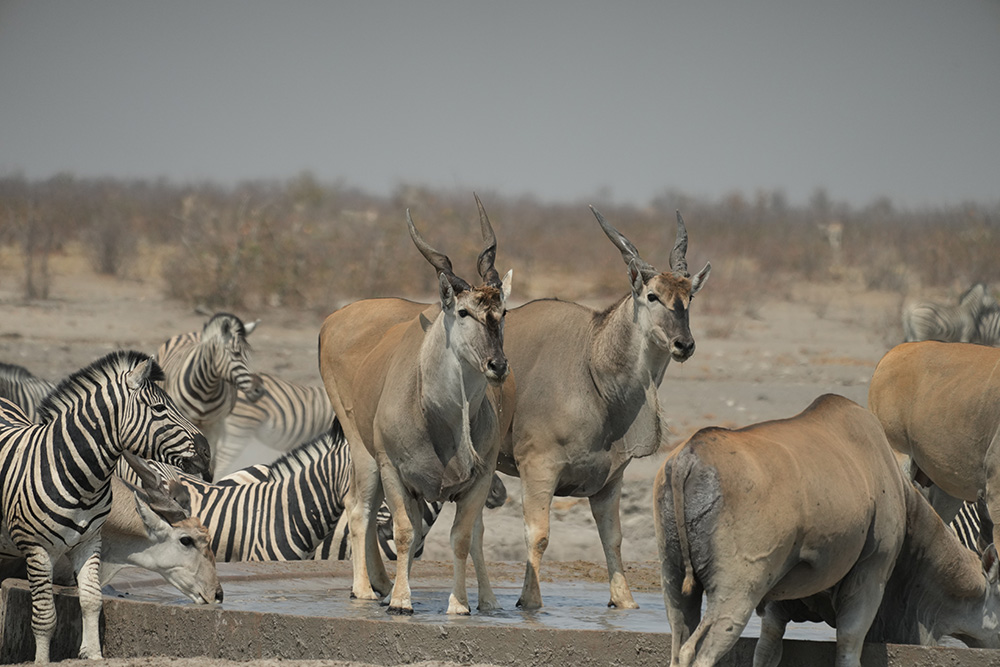
Two options: sit at a floodlit in-camp waterhole (available at Okaukuejo, Halali, Namutoni and Olifantsrus), or book a guided night drive from any of the six NWR camps. Night drives must be booked at reception — they are extremely popular.
Floodlit In-Camp Waterholes
Four of the six camps have waterholes you can watch from inside the camp at night, no booking required: Okaukuejo, Halali (Moringa), Namutoni and Olifantsrus (two-tier hide). Black rhino are most commonly seen at night, as are lion, hyena and leopard. Take a torch for walking back to your chalet.
Guided Night Drives
Available from all six NWR camps inside Etosha. Run in open vehicles with a spotlight. Nocturnal species — aardvark, genet, scrub hare, and sometimes pangolin or aardwolf — are only reliably seen this way. Book immediately on arrival — places are limited and fill up fast every day.
Wildlife Spotting Tips for Etosha
Sit at waterholes, drive slowly (20–30 km/h), take binoculars, and talk to other visitors about recent sightings. Patience at a waterhole consistently outperforms driving around all day.
Sit at waterholes
The single most effective strategy. In Etosha's dry, harsh environment everything must drink — including predators and rarely-seen nocturnal species. Two hours at a productive waterhole will show you more than a full day of driving. Scan the shady bushes on arrival: lion and cheetah often rest there before approaching.
Drive slowly
The speed limit is 60 km/h, but 20–30 km/h is far better for spotting. You can scan under bushes, notice ear flicks in the long grass and spot birds that would otherwise blur past.
Use binoculars
Etosha's flat, open landscape offers sightlines across several kilometres — but identifying animals at distance is impossible without binoculars. Essential for birding. Good for scanning under bushes and across the pan edge where distant herds appear as dark specks.
Talk to other visitors
Most Etosha visitors are happy to share sightings — a simple question at a waterhole or camp can save hours of searching. If someone just saw lions at Rietfontein, it is worth heading there.
Check the boards at camp
Some NWR camps maintain sighting boards at reception where guests log what they've seen and where. Read these every morning before heading out.
Frequently Asked Questions — Etosha National Park
What are Etosha National Park gate opening times?
Gates open at sunrise (approximately 06:30) and close at sunset (approximately 18:30 in summer, 18:00 in winter). Exact times are posted at each camp gate daily. Always check at reception — do not rely on other visitors.
What are the Etosha park entry fees for 2026?
Foreign adults: NAD 150 per person per day. Foreign children (9–16): NAD 100. SADC adults: NAD 100. Namibian adults: NAD 50. Vehicles up to 10 seats: NAD 50 per day. Fees are non-refundable, non-transferable and valid for 24 hours from time of entry.
Do I need a 4WD vehicle to drive in Etosha?
No. A standard 2WD car can manage all main Etosha roads in dry conditions. However, a high-clearance SUV or bakkie (pickup) is strongly recommended for comfort on corrugated gravel roads and better game-viewing sightlines.
How many camps are inside Etosha and who runs them?
Six camps, all run by Namibia Wildlife Resorts (NWR): Okaukuejo Resort, Halali Resort, Namutoni Resort, Onkoshi Eco Resort, Dolomite Eco Resort and Olifantsrus Camping.
What is the best time of year to visit Etosha?
May to September for the best game viewing — dry season concentrates wildlife at waterholes and vegetation is low. April and November are the best value months with fewer visitors. December to March is hottest and wettest but excellent for birds and the landscape is green and striking.
Can I see rhino in Etosha?
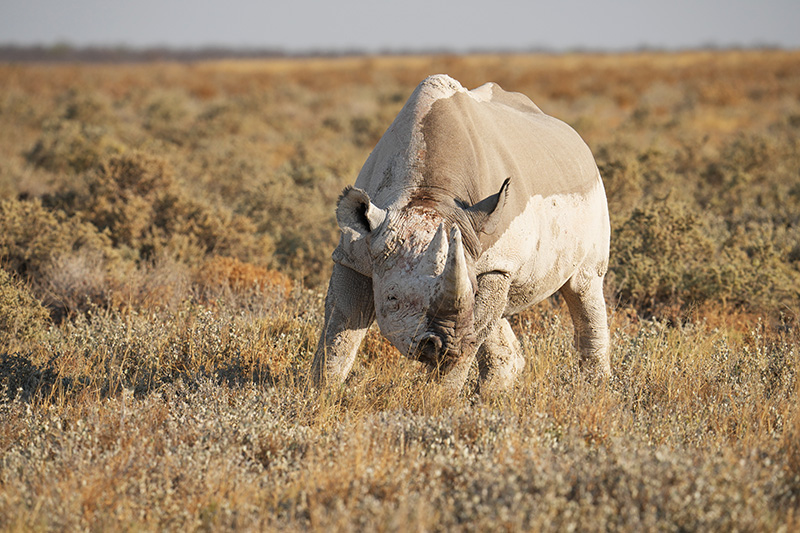
Yes — both white and black rhino. White rhino are seen regularly at waterholes, particularly at Okaukuejo at night. Black rhino are more elusive; best chances are at the Okaukuejo waterhole after dark, at Halali, and in the western section near Dolomite.
Is there malaria in Etosha National Park?
Low-to-moderate risk, not a high-risk zone. Risk is highest November–April (rainy season). Use insect repellent, sleep under nets, wear long clothing after dusk, and consult your doctor about prophylaxis before travel.
Are Etosha camps fenced?
Four camps are fenced: Okaukuejo, Halali, Namutoni and Olifantsrus — you can walk freely inside these at night. Two are unfenced: Onkoshi and Dolomite. At unfenced camps, always ask staff to escort you after dark and take extra precautions at all times.
Do I need to book Etosha in advance?
Yes. The six camps inside Etosha have limited capacity and fill up, especially May–October when popular room types book more than a year ahead. Do not plan to arrive without a reservation during peak season.